Article
From fragmented to governed: The future of healthcare data
Average read time: 2.5 minutes
Healthcare doesn’t have a data creation problem—137,000 terabytes of healthcare data are generated daily in the U.S., growing 36% year over year. The real issue? A staggering 97% of that data goes unused due to usability challenges. This isn’t just random, floating data. It’s patient data, health history and critical clinical details that should support every clinical decision. The question isn’t whether the data exists. It’s whether organizations can build a trusted data foundation that makes data usable and trusted that unlocks a multiplier effect that turns one investment into value across multiple use cases.
The 75% problem
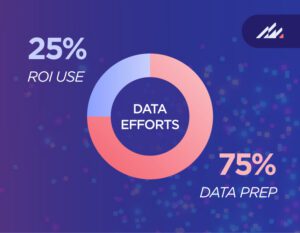 Today, 75% of healthcare organizations’ data efforts are spent on locating, cleaning, and validating data to ensure its relevance, usability, and quality. That leaves only 25% for the analytics and application use cases that actually deliver ROI. These fragmented, manual approaches force organizations into inefficiency. Quality scores, care coordination and patient engagement become siloed initiatives, each rebuilt from scratch. Without a trusted data foundation, every new initiative inherits the same data quality problems. Analytics become unreliable, users lose confidence, and the potential multiplier effect of reusable, governed data only spreads risk faster. So how do we fix this? It starts with real-time governance.
Real-time, AI-powered data governance
Real time data governance leveraging a modern intelligence platform enables continuous monitoring and quality assessment. Machine learning improves data quality, mapping accuracy and anomaly detection at scale. A data ingestion layer acts as a bridge collecting, validating and routing data from diverse sources such as clinical records, claims, social determinants of health and even unstructured documents.
From there, AI–powered mapping converts varied terminology into standardized code sets, creating harmonization and consistency across the board. The result is a trusted data foundation with full transparency-trust scores, data lineage tracking and the ability to exclude low-quality data feeds. This creates a single source of truth with real-time processing and enables up to 70% data reusability across multiple use cases. That reusability is the multiplier effect in action. Organizations shift from spending 75% of their effort on “data plumbing” and instead can focus on high-value analytics and AI applications that actually deliver for clinicians and patients.
Today, 75% of healthcare organizations’ data efforts are spent on locating, cleaning, and validating data to ensure its relevance, usability, and quality. That leaves only 25% for the analytics and application use cases that actually deliver ROI.
Real-world impact: Turning clean data into revenue
Data governance isn’t just a compliance exercise—it’s the foundation for healthcare’s digital transformation. When a trusted data foundation addresses critical data gaps, the result is comprehensive clinical data availability and synchronized patient history across applications enabling seamless comparison, trending and reporting while reducing costs and improving outcomes. Clinicians shouldn’t have to leave their EHRs or disrupt their workflows. They should be able to quickly locate key details through intuitive search and access standardized, trusted data wherever care is delivered. And because a trusted data foundation is reusable by design, every additional use case built on that foundation compounds the return. The multiplier effect turns modest investments into substantial value. Read more about how to transform fragmented data into your organization’s most strategic asset here.
SUBSCRIBE TO OUR INSIGHTS
Dive deeper into how we are elevating healthcare
About the author