
Article
Walking the halls: Behind the scenes at Hollywood Presbyterian Medical Center
We arrived just before eight. The morning was clear and as we made our way into the hospital, I looked around and did my best to orient myself. I saw a few patients waiting in the admissions area. At the elevators, we were headed down toward the IT offices while many other hospital staffers waited to go up and into their shifts. The team I was with was there to continue support for the hospital’s EHR upgrade to Paragon® Denali, a big feat that, at that time, was still fresh, having only switched over two days before.
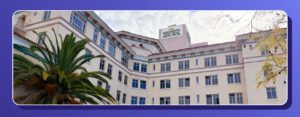
Situated on the corner of Vermont and Fountain Avenues, Hollywood Presbyterian Medical Center (“HPMC”) straddles Los Angeles’ Little Armenia and East Hollywood neighborhoods, but in reality, it is central to many others. A full-service acute care hospital serving the diverse Hollywood community and others with comprehensive medical services, it was founded in 1924 as Hollywood Hospital, but grew steadily with Los Angeles’ population, later joining CHA Health Systems in 2005.
We got to the IT headquarters of the hospital which were located in the basement and some of the core Paragon team members had already set up shop and were into the day’s work. As the Paragon Denali upgrade was taking hold, I learned quickly that it didn’t mean our job was done. The system was up, yes, but there were pieces that still needed to be smoothed out. A tiny bug here and there needed attention. Was the printer printing face sheets? After I introduced myself to the teams (Altera’s and HPMC’s), I sat down at the long table for approximately two minutes before Paragon’s Chief Nursing Officer, Geoff Nau, stood and said he was heading upstairs to check in with a few users from a few departments. And thus began the day I was geared up for: To watch how a hospital lived and breathed.
Out of the basement and into the day
The hospital campus is split between two buildings, the doctors tower—for more outpatient care—and the patient tower, the nucleus for inpatient services. (A note on the facility: HPMC is undergoing a massive expansion, with a new five story patient tower targeted to open in 2027).
Geoff and I chatted with hospital staff as we made our way around, often stopping to ask how their days were going. Within minutes of arriving at the registration desk for the ER, I saw the theme of our work rolling out before us. Geoff introduced himself and asked them if there were any problems with the system. For some, the question seemed to sneak up and tap them on the shoulder. They didn’t immediately know how to answer, or, maybe, if they should answer. After a pause, Geoff reached out to shake their hands, offering that he was from Altera and that he wanted to check in on the new system. More than anything, though, he made it clear that he wanted to know exactly what wasn’t working quite yet.
Each user we talked to the whole day seemed to be some version of shocked, wary or both, though ultimately accepting Geoff’s invitation to talk through the system and everything that was new. It was in the emergency department, early in the day, that the essence of our jobs as an EHR vendor became clear. We weren’t there to flip the switch and walk away. We didn’t merely issue a receipt and pack up for the next go-live. What started there was more than the team simply solving problems. It was when a user started to mention an issue they noticed with the system that Geoff sat down and said, “Tell me more.”
Up and down, and back again
As Geoff and I went from the ED, to the ICU, to cardiology, he made it clear to every user we spoke to that we would be back to check in later. By noon, everyone we’d interacted with knew our names, understood why we were there, and in a few cases, had Geoff’s cell number to text him as needed. Altera’s software was soon eclipsed by the trust we were building by actually being there with them onsite. An understanding was reached that any tech challenges would be resolved. Geoff and the rest of the team remained open to hearing what needed to be heard.
We were met by a man who I quickly found out was a new father Geoff had met the day before. The two spoke briefly. About the baby’s name and how the mother was doing. They shook hands and parted ways and we entered Labor & Delivery. Just as we had with the other departments, Geoff introduced us and asked what he could help with. Soon, he was seated next to a nurse, walking her through the new discharge process in Paragon Denali. She explained her initial confusion. “Tell me more,” is all Geoff said. Within 15 minutes, the nurse was up to speed. The documents were ready. The mother and baby’s discharge was underway.
There’s a deep level of trust that’s been established, and I’m thankful now that when there are things that need to be fixed, the Paragon team’s accountable. They aren’t shy about being here and stepping up to get us to where we need to be.
Defining a partnership rooted in trust
After our time in Labor & Delivery, Geoff circled back with the Admissions team and I stopped by the hospital’s IT manager’s office. Clark Guico, who for most of the morning had been bouncing back and forth between the Paragon base camp, his colleagues’ offices and the rest of the hospital, was just returning to check on a fix for the Radiology department. For someone so busy managing the hospital’s vast IT needs, Clark seemed at ease. When I asked if he had a few minutes to chat about the Paragon Denali go-live and the days following, he was quick to take his seat at his desk, turning his whole attention to me. I sat on the couch under framed Kobe Bryant posters and once I finished complimenting his workspace décor (and the impressively authentic Light Saber displayed on the front of his desk), we got to talking about Paragon Denali. From his perspective, informed by his experience as an Emergency Room nurse and seasoned IT expert, the go-live was a success. Contributing to that success, he said, is the shoulder-to-shoulder relationship he has built and strengthened with the people behind Paragon Denali. He went on to say, “When I first started in this role, it was a process of opening up a case. Then going back and opening up another case. Waiting. Then, when that didn’t work? Now we’re on a call and try to figure it out. But, that’s all gone now.”
I pushed for Clark to speak on the process now, to which he said, “We still open cases. That’s a good way to keep track of everything. But if we really need to get on to something, we collaborate. . . With the Paragon team now, it’s essentially us saying, ‘Something’s not right,’ and basically in real time I am able to connect with someone and talk it through. We feel supported that when there is a problem, you can reach out to anybody from this team. There’s a deep level of trust that’s been established, and I’m thankful now that when there are things that need to be fixed, the Paragon team’s accountable. They aren’t shy about being here and stepping up to get us to where we need to be.”
We talked for nearly 20 minutes and at the end, one thing Clark said stayed with me: “[Hollywood Presbyterian Medical Center] has a guiding mission this year to elevate. Elevate the culture. Elevate the community, in and out of the hospital. But most importantly, to elevate the patient experience from the time they walk in, to the time they walk out. No matter what, patient care is number one. And it feels good to know that this drive is shared by everyone at Altera.”
A clearer and stronger path forward
Walking out the hospital doors, I stopped on the corner and looked north toward the mountains. The iconic Hollywood sign looks over the city. An ambulance pulled into the ER bay. A couple hospital employees sat on a bench, taking a break or getting ready for a night shift. I passed a woman pushing a child in a stroller with a dog in tow. Across the street, a bus stop was packed with people on their way elsewhere. The traffic never let up. It felt like everything I saw inside and outside the hospital might have been connected, knowingly or not. But that’s what community is.
My goal that day was to peek behind the scenes, to get a firsthand look at how Altera supports our users. To be away from my desk, walking the halls of a client, seeing first-hand how the hospital operates. My mission was only made more complete by understanding outright how the trust the users had in us is a part of the story of how the hospital takes care of the people in the community.
SUBSCRIBE TO OUR INSIGHTS
Dive deeper into how we are elevating healthcare
About the author
