
Article
Throughput is a care quality issue, not a back-office problem
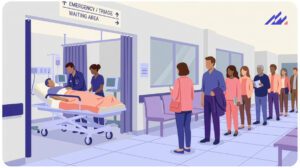
As physicians, we’re trained to identify problems quickly, prioritize them accurately, and act decisively. Yet one of the most persistent threats to patient care doesn’t show up in a lab value or imaging result. It shows up in the hallway. Patients waiting on gurneys, ED hallway boarding and a bed that “should be available soon” but isn’t. A discharge completed at 10 a.m., with the room still unavailable at 4 p.m. These aren’t inconveniences—they’re signals of a system under strain.
From a physician’s perspective, throughput isn’t an operational problem, it’s clinical. When patient flow slows, safety erodes, burnout accelerates and the patient experience suffers.
The bottlenecks we all feel
Throughput breakdowns rarely stem from a single failure. They accumulate quietly across the system:
- Bed status that lags behind reality
- Discharges that are clinically complete but operationally delayed
- Housekeeping, transport and unit teams working in silos
- Reliance on calls, whiteboards and workarounds that don’t scale
What makes this especially frustrating is that frontline clinicians have the least visibility and the least control over these constraints, even as they absorb the consequences.
When throughput breaks down, risk goes up
Extended ED wait times are associated with increased mortality and adverse events. Studies have shown that prolonged ED boarding and crowding correlate with worse patient outcomes, including higher inpatient mortality rates.
Delayed admissions disrupt continuity of care, and boarding patients in non-specialized settings stretches staffing ratios and limits appropriate monitoring. The American College of Emergency Physicians has repeatedly identified ED boarding as a direct threat to patient safety.
Physicians can make timely decisions and care teams can execute with precision, but without coordinated workflows, real-time visibility, and aligned communication, improvement plateaus. When systems don’t support flow, even the best teams struggle. Physicians now spend nearly two hours on EHR and desk work for every hour of patient care, largely on coordination inefficiencies rather than medicine. We hold clinicians accountable for outcomes while forcing them to work in fragmented systems that obscure real-time insight. Until throughput is treated as foundational to patient safety, staff sustainability and care quality, delays will remain normalized instead of solved.
The financial impact is real—but it’s not the root problem
When patient flow lacks transparency, hospitals lose capacity without realizing it. Research shows that improving bed turnover and throughput can increase effective capacity by 5–15% without adding beds. Meanwhile, ED boarding alone is estimated to cost hospitals millions annually in lost revenue and inefficiency. The financial implications matter. They limit reinvestment in staff, services and innovation. But the root issue isn’t financial—it’s operational clarity and coordination.
Metrics that matter
Throughput metrics shouldn’t feel abstract. The ones that matter are the ones we experience every day:
- Time from ED arrival to inpatient bed
- Time from discharge to room readiness
- Length of stay driven by non-clinical delays
- The steady creep of LOS despite appropriate care
Even modest delays add up. A study found that non-clinical delays can account for up to 20% of total hospital length of stay, representing significant opportunity for improvement. These aren’t just operational KPIs—they’re indicators of whether the system is enabling or obstructing clinical decision-making.
What if systems moved at the speed of care?
What if bed availability reflected reality in real time?
What if discharge triggered immediate, coordinated action across teams?
What if clinicians could trust that once care is complete, the system carries the patient forward—without friction?
That’s the shift we should expect.
And it’s exactly where solutions like Sunrise Access Manager and Patient Flow are focused—bringing real-time visibility, coordination and accountability to one of healthcare’s most persistent challenges.
References
- Sun BC, et al. Effect of Emergency Department Crowding on Outcomes. New England Journal of Medicine, 2013
- Singer AJ, et al. Association Between ED Boarding and Mortality. Annals of Emergency Medicine
- Sinsky C, et al. Allocation of Physician Time in Ambulatory Practice. Annals of Internal Medicine, 2016
- American College of Emergency Physicians – ED boarding policy statements
- American Hospital Association – hospital capacity and financial impact reports
- Institute for Healthcare Improvement (IHI) – Throughput and flow improvement data
- BMJ Quality & Safety – Studies on delays in hospital discharge and LOS
SUBSCRIBE TO OUR INSIGHTS
Dive deeper into how we are elevating healthcare
About the author